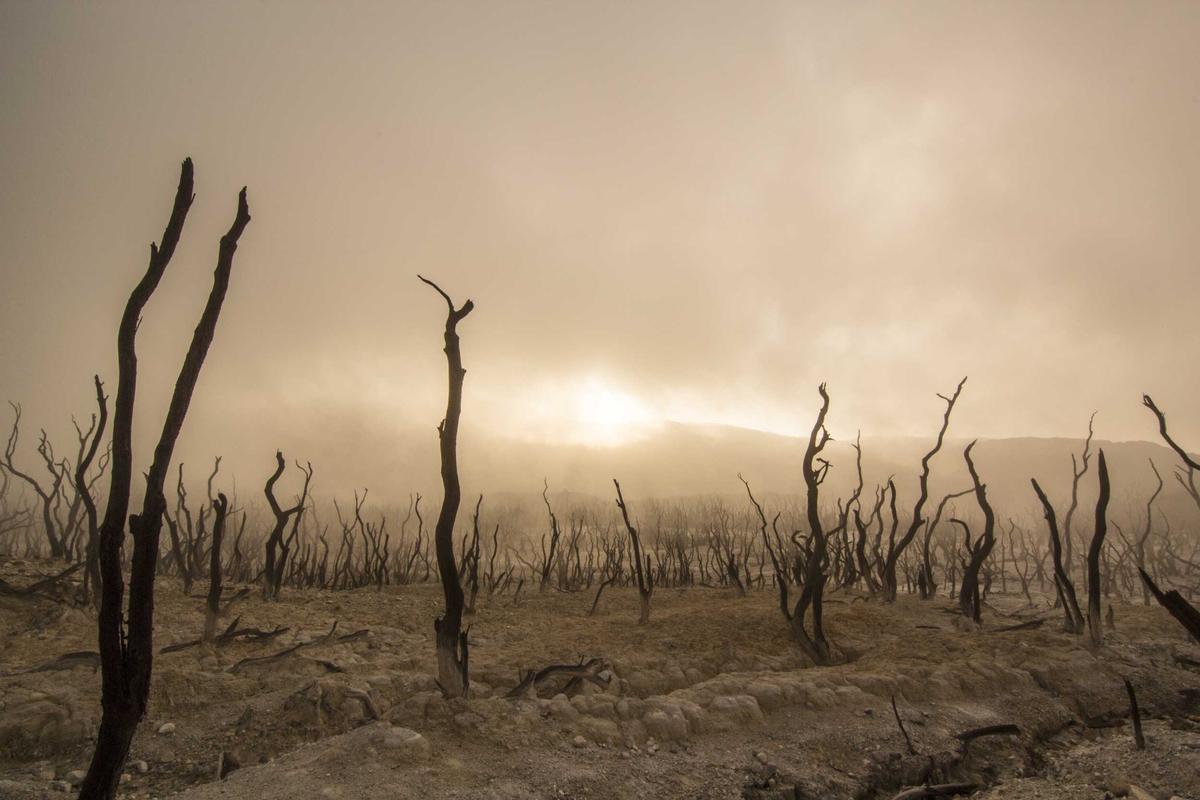
A fast-moving wildfire in Greece has escalated beyond local control, prompting the deployment of RAF helicopters to reinforce exhausted firefighting crews. The blaze, reported in the volatile Attica region, is not merely a natural disaster. It is a threat vector that exposes critical seams in European crisis response and military readiness.
When the British Ministry of Defence confirms the launch of rotary assets from RAF Akrotiri, one must read beyond the humanitarian headline. Such mobilisations are rarely charity. They are a strategic pivot to protect an exposed NATO flank.
Greece's fire season has become a recurring operational liability. Its terrain, choked with dry brush and rugged hills, forms a natural chokepoint for ground access. The decision to call in RAF Chinooks or Merlins, assuming those models are deployed, reflects a failure in domestic logistics.
Athens cannot secure its own territory without external airlift and firefighting capacity. This is a soft underbelly that hostile actors will log for future reference. Intelligence failures here are twofold: failure to pre-position adequate aerial firefighting assets, and failure to anticipate the scale of drought conditions driven by climatic shifts.
The RAF's involvement, while necessary, diverts airframes from primary mission sets in Eastern Europe and the Mediterranean. Each hour a helicopter spends on water-bombing operations is an hour it cannot spend on ISTAR or tactical transport. This is a cost-benefit calculation that should trouble the Joint Forces Command.
Moreover, the blaze's proximity to key infrastructure demands scrutiny. If it encroaches on power grids, communications nodes, or coastal radar installations, the operational impact could ripple through NATO's southern corridor. The timing is also suspect.
As Turkey escalates rhetoric over Aegean sovereignty, any degradation of Greek command-and-control capabilities becomes a geostrategic gift to Ankara. This is why the response must be calibrated as both a humanitarian aid package and a force protection measure. The underlying lesson is clear: European firefighting capacity is a hollow force.
Nations rely on ad hoc mutual aid rather than permanent, integrated staging bases. The RAF deployment is a stopgap, not a solution. Without a sustained investment in joint firefighting logistics, these fires will become a recurrent emergency that bleeds readiness from frontline units.
The real battle here is not against the flames but against bureaucratic inertia and underinvestment in resilient infrastructure. If this fire spreads to affect radar sites or airfields, the intelligence community should treat it as a symmetrical blow to NATO air defence coverage in the eastern Med. For now, the RAF's rotors are turning, and the metrics of success will be measured in hectares saved and hours flown.
But the strategic scorecard demands a harder question: what is being left unguarded while we fight this fire?