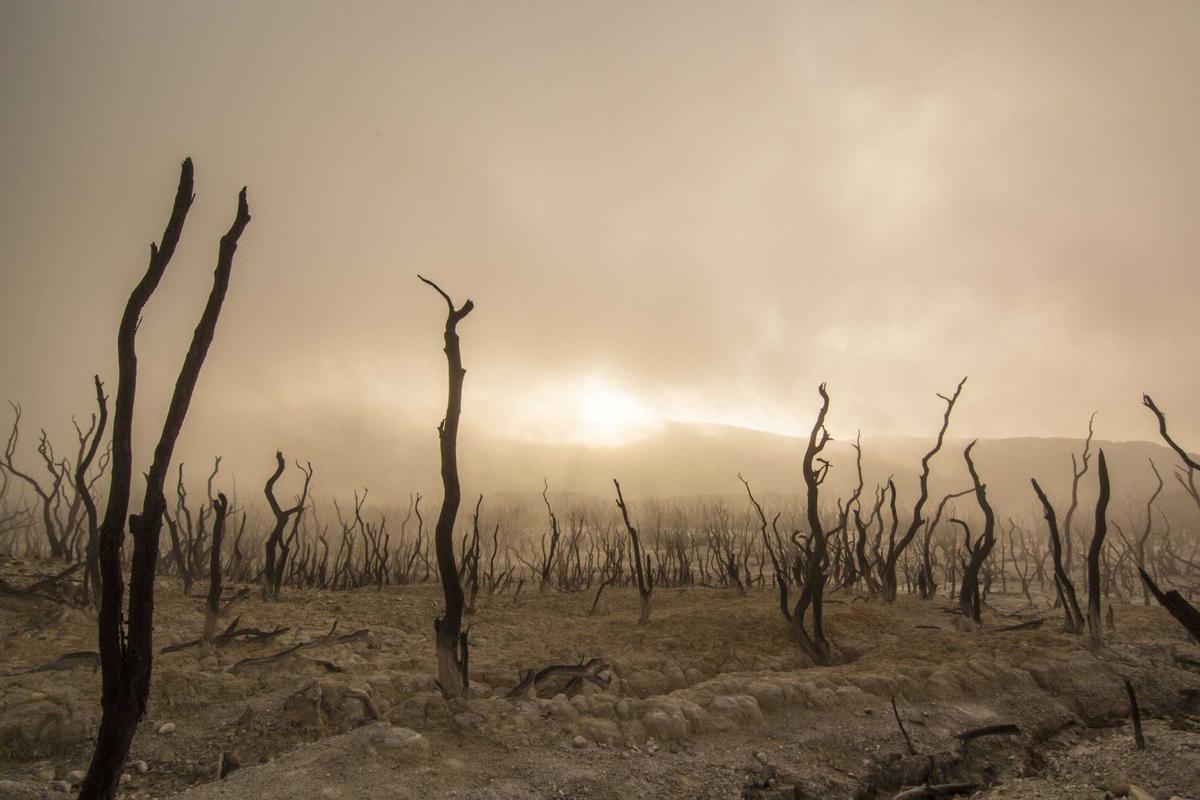
A heat dome parked over western Europe has driven French thermometers to an unprecedented 44.9°C in the shade, deepening a societal fracture that runs along the window sill: those with air conditioning and those without. In Paris, the wealthy retreat to sealed apartments humming with split units, while working-class arrondissements swelter in urban canyons designed decades ago for a cooler world. The data are stark: fewer than 15% of French homes have AC, and this week's mortality spikes in the elderly and infirm will be attributed not just to temperature but to inequality of access. Meanwhile, across the Channel, the UK energy secretary announced that renewables supplied 73% of national electricity during the early afternoon peak, a record that vindicates the country's accelerated offshore wind programme. The contrast could not be more instructive.
The physics of this crisis is simple: greenhouse gases trap more infrared radiation, raising the baseline of global temperature. Europe has warmed roughly 2°C since pre-industrial times, but the tails of the distribution are stretching dramatically. A 44.9°C reading in France is not 2°C hotter than the old record; it is the climate system loading the dice to produce events that have no historical analogue. The heat dome itself is a manifestation of a weakened, wavy jet stream—a pattern linked to Arctic amplification. In plain language: the poles are warming faster, reducing the temperature gradient that drives the jet, making it meander and park stagnant high-pressure systems over continental landmasses. This is the fingerprint of anthropogenic climate change.
The air conditioning divide is a second-order crisis. As temperatures rise, the pull of mechanical cooling becomes irresistible, yet adoption remains highly unequal. In France, the wealthy retrofit their properties while landlords of rent-controlled buildings hesitate. The result is a thermal class system: the rich can purchase survival, the poor must endure. But this is not a stable equilibrium. Heat stress raises cortisol levels, impairs cognitive function, and exacerbates chronic conditions. The financial cost of lost labour productivity and emergency room visits far outweighs the investment in passive cooling design. Yet the market alone cannot solve this; building codes need to mandate reflective roofing, external shutters, and green infrastructure. The UK's rapid scaling of renewables, by contrast, demonstrates that coordinated public investment can alter energy trajectories. The offshore wind which met that peak demand was installed under government contracts that guaranteed prices and de-risked private capital. The electricity itself is cheap, but the transition required state-led industrial planning.
Technological solutions are not neutral. Heat pumps can provide cooling more efficiently than standard AC units, using the same vapour-compression cycle in reverse. If powered by decarbonised electricity, they break the feedback loop of burning fossil fuels to stay cool. Yet adoption lags because upfront costs exceed what low-income households can bear. The solution is a social tariff for retrofits, funded by carbon taxes on high emitters. This is not socialism; it is risk management. The alternative is a world where the rich live in weather-sealed bubbles and the rest gasp in heat islands. That is not a political statement but a thermodynamic one: unequal resilience to heat means unequal death rates.
The data coming out of France this week will be brutal. Excess mortality calculators will quantify the cost of inaction. Meanwhile, the UK's 73% renewables figure offers a blueprint: aggressive deployment of wind and solar, coupled with battery storage and interconnection, can decarbonise power while maintaining reliability. The vindication is not in the record itself but in the demonstration that the energy transition is physically possible. The challenge now is to extend that logic to the building stock, to transport, to industry. We have the tools. What we lack is the collective will to distribute them equitably before the next heat dome arrives.
This is not a weather report. It is a report on the state of our society as reflected in the state of our climate. The thermometer is a mirror. Look at it.