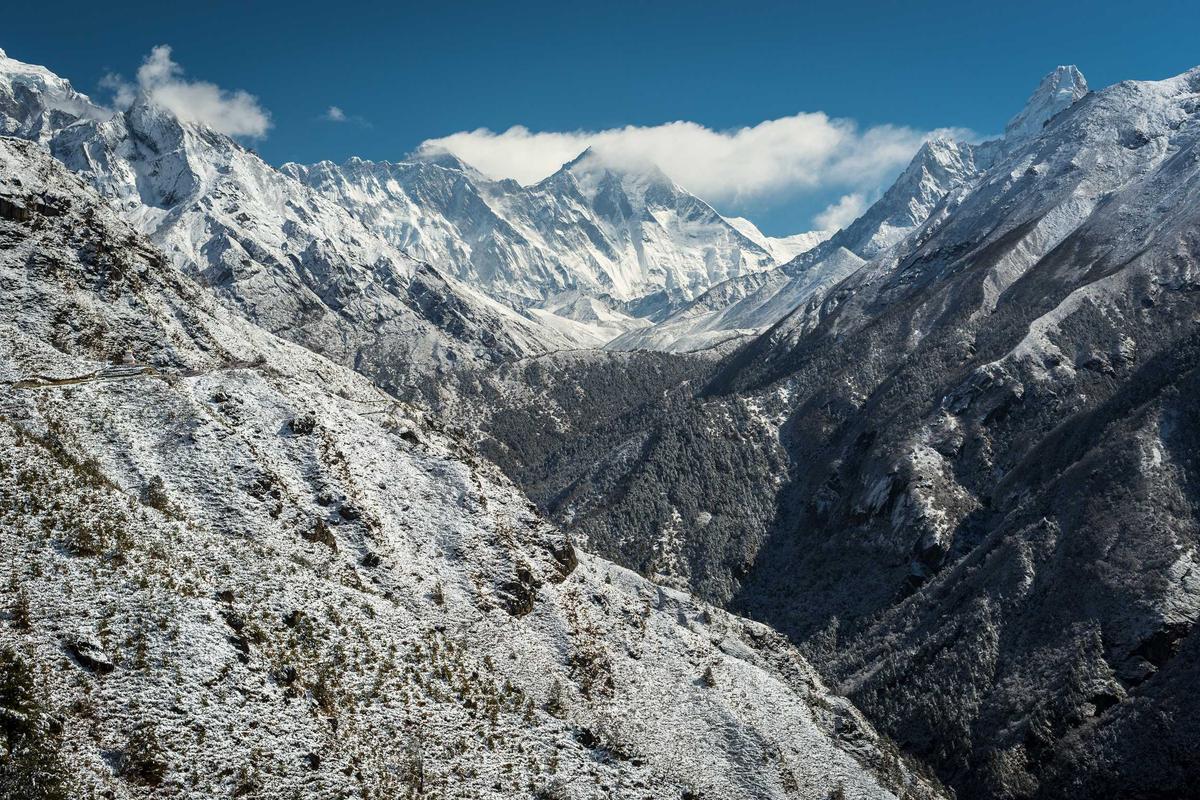
The Khumbu Icefall is a churning cathedral of seracs and crevasses, a threat vector that claims lives with the cold efficiency of a cruise missile. When a Sherpa guide went missing near the summit of Mount Everest, the strategic calculus shifted from a commercial climb to a high-stakes recovery operation. The British-led rescue team that brought him down alive is being hailed as a ‘miracle’. But in military terms, this was no miracle. It was a textbook execution of a vertical extraction under extreme duress, a case study in logistical precision and the failure of conventional risk assessment.
The missing Sherpa, a veteran of multiple summit pushes, was last seen navigating the South Col route when a sudden weather front collapsed visibility to zero. In the death zone, where oxygen levels are a fraction of sea level and the human body begins a slow, irreversible decay, a delay of hours is a death sentence. The team, led by a former British Army mountain specialist, executed a forced insertion using advanced climbing techniques and satellite communications that would make a special forces unit proud. They bypassed the bottleneck of slower teams, establishing a forward operating base at Camp IV to stage the recovery.
This success points to a critical flaw in our current understanding of high-altitude operations. The prevailing wisdom treats Everest as a purely civilian endeavour, a bucket list item for wealthy adventurers. But the Khumbu Icefall is a contested environment, and every climb is a military operation in miniature. The rescue team’s use of real-time telemetry and pre-staged oxygen caches mirrors the logistics of a mechanised battalion on the move. Yet the broader climbing community remains reactive, treating every emergency as an isolated event rather than a systemic risk.
The rescue itself was a close-run thing. The Sherpa was found hypothermic, with early signs of frostbite in both hands. The evacuation required a coordinated descent through the Icefall, a maze of shifting ice that is effectively an active warzone. Avalanches are the equivalent of light artillery: unpredictable and devastating. The team’s discipline in using fixed lines and maintaining constant voice contact kept them clear of the kill zones. This was not luck; it was training.
What is the threat? It is our complacency. Every year, we see a steady stream of fatalities in the Himalayas, and each one is treated as a tragic inevitability. But the technology and tactics exist to reduce these losses. Drones can drop oxygen bottles. Satellites can map ice movement. None of this is secret. The failure is in our doctrine.
For the intelligence community, this rescue is a data point. It confirms that British mountaineering teams possess the capability to project power into extreme terrain. But it also exposes a vulnerability: our reliance on individual heroism rather than institutional support. The rescue team operated without a formal mandate or a chain of command. They improvised. And improvisation, in hostile environments, is a two-edged sword. One misstep, and a rescue becomes a recovery.
The ‘miracle’ is a narrative that distracts from the real lesson. We need to treat every climb as a potential combat operation. We need to pre-position assets, standardise communication protocols, and train for the worst-case scenario. The Sherpa is alive because a few individuals refused to accept the statistical probability of his death. But statistics are not strategy. The next missing climber might not be so lucky. The strategic pivot is to move from reaction to prevention. Every mountain is a threat. And we are not prepared.